Centenary Festival · Phase Two · Wednesday 2 September
The Beckoning Future and the Holistic Power of Polarities
The Shaping of Living Wholes
Richard Cox · The Future is Calling Us
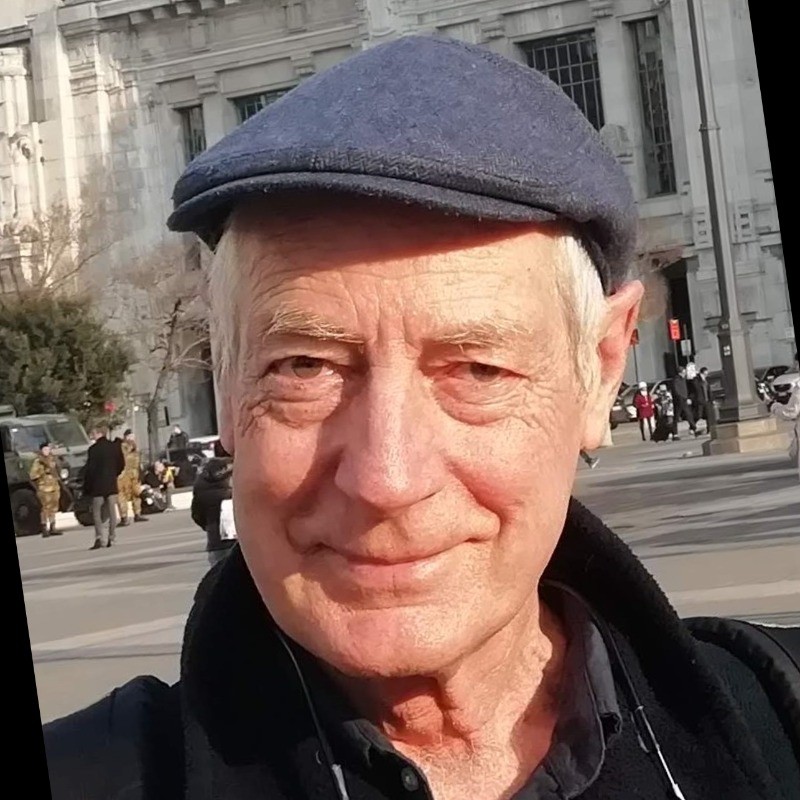
As a teacher and author, in our age of scientific materialism, Richard Cox finds Smuts' vision and insights indicate a clear direction to lead us back to spiritual dimensions with complete rational clarity. Richard's recent book 'Of Signs and Signatures: Reading Nature's Script with Goethe and Smuts' is principally an overview of the various holistic insights that we find in mathematics, optics, botany and zoology.
Watch the recording
Recorded Wednesday 2 September, 19h00 CEST. The full transcript is available below and as a downloadable PDF.
The full session
Read the transcript
Abstract
Richard Cox builds his talk on one sentence from Jan Smuts. A living whole is explained by its future as well as by its past and present. Cox asks us to carry two phrases through the evening: the seeds of the future and the pull of the future. Organic farming and thirty years of Waldorf teaching led him to the resonance between Goethe and Smuts. That resonance became his book Signs and Signatures. Reading nature, he says, is like reading between the lines. It asks for careful attention to gestures and polarities. Radiating meets enclosing in the pine and the acacia. Movement meets rest and gives rise to rhythm, in flags and waves.
Cox then turns to living forms. Goethe saw leaves change into petals and linked this to Proteus. The young and the adult chimpanzee suggest that the human form holds specialization back. Smuts called this restraint. The skull, chest and limbs echo the polarities of rest, rhythm and movement, and thinking, feeling and willing sit with them. Wolfgang Schad's work shows rodents, carnivores and ungulates repeating a threefold pattern in temperament, teeth and jaw movement. Embryos, the human hand and the white of the eye show an unspecialized human form. A long childhood in the care of mothers keeps that openness alive.
Cox closes with education. In his school he kept learning broad and kept every potential open, so that thinking, feeling and willing all grow. Premature specialization can close possibilities. Teachers must stay open to a world that is calling. In the dialogue, Rod Kersh asks about specialists, and Cox replies that the concern is premature specialization. Jeff Blumberg, Glen T. Martin, Marlene De Lange and Marcus Link connect the talk to nature's patterns, governance, personality and the two hemispheres of the brain.
Transcript
Welcome and introduction — Claudius van Wyk
Claudius van Wyk: Okay, well, we've just gone on the hour. So, I think we can probably start. I'm going to invite all the participants. A few more minutes. The people are still coming. They're still coming in. So, as you come in, would you maybe put in the chat your name and where you are connecting from? So we can actually see who's with us. So that's the first invitation, and the second invitation is, we'd love to see you! We'd love to see you. So, if we see you showing signs of shock, that'll be an interesting indicator for our presenter.
We also have Christopher Cooke, who's with us. Christopher Cooke is going to be the closing speaker for this year, where he talks about the next evolutionary potential for humankind. So, we're diving in, into the deep. What Egon Hus, our co-developer, calls the liminal space. Okay, so folks, put in your place of abode and your name so we can see you. Switch on your camera. And then… I think I'm just going to start off then. Today, in a week, will be the very infamous 9-11 day. That's the day when the Twin Towers was brought down. Very controversial.
But there was another tragedy, and that was it's also the day that Smuts died. In 1950. 9-11 is the day that he died. Died, I believe, quite broken-hearted. That what he stood for seemed to have crumbled around him. But a hundred years later, we're rediscovering his legacy. And my own sense is… that the gift of Holism that he gave to the world is probably the greatest gift humankind has received in the 20th century. I can't think of a greater gift in the 20th century, in my limited understanding of things. And what has been so utterly gratifying is the generosity with which people have participated in this ongoing festival. 2026.
Nobody's being paid. Everybody's just offered their wisdom and their insights and their years of research voluntarily. And so it is a great honor and a great pleasure to welcome our speaker tonight, Richard Cox. Richard, you've just published a book. You're going to share that with us briefly, and we look at… you sent me a copy, but it got lost in the mail somewhere. Hit that copy. Richard is a teacher by profession. He's also done farming. Richard's passion has been both history, but also re-looking the whole issue of nature sciences. How do we understand nature? And what Jeff pointed out in his presentation is Smuts's wanting us to see nature through nature's eyes.
That if we could see nature through nature's eyes, we would get a fundamentally transformed view of spirit. A view of spirituality not as an otherworldly dimension, but an in-year, dynamic, unseen dimension. And that leads to the patterns that have articulated life. That have articulated through the evolution that has brought us to this amazing occasion where we can talk about it, with this technology that enables us to connect from all around the world. So it was with great, great pleasure that I hand over to you, Richard, to take us away.
Opening: Smuts's holistic view of evolution — Richard Cox
Richard Cox: Well, thank you very much for that, Claudius. Good evening, everyone. It's lovely to be here with people who understand and value Smuts's huge contribution towards a wholesome and, I would call a sympathetic perspective on life. Yeah, it's… well, it's more than lovely, it's absolutely amazing. Every contribution of this festival has brought riches, and for that, I'm very grateful. So thank you, Claudius, and the team, for organizing this remarkable event. And thank you for inviting me to participate in the celebration. As Claudius mentioned, I've recently published a book, Signs and Signatures, and a lot of what I'm sharing this evening comes out of my research that went into that book.
So I'm delighted to have the opportunity to share what is so close to my heart, and has been close to my heart, most of my life. Evolution in the popular literature has been shaped by writers like Dawkins, where survival of the fittest and the elimination of the rest has become the sort of biological gospel. And I hope this evening to show how radical and wonderful Smuts's holistic perspective on evolution is, for both education and nature studies. Smuts has provided insights that recognize great depths of wisdom and meaning, where so much has been canceled and denied.
Evolution, the wonder, has become evolution, accident. Not for all scientists, but science in general tends to see life as matter in motion, and spirituality has been banished into the realm of the humanities. Smuts provides a firm and wonderfully positive [unclear] that has direct, practical implications. I plan to take you on an experiential journey that provides you with clear evidence of a deep, holistic order. And with wonders of nature that Smuts intuitively recognized. And that have… directed… that have direct implications for education. So this evening, what I'd like to do is to focus on living forms.
There will be a bit of botany and a bit of zoology. And that will lead to my work as a farmer and teacher. So that is the kind of direction I'm taking, but I'd like to begin with a bit of the background that got me to this point.
From farming to teaching, and to Goethe and Smuts — Richard Cox
Richard Cox: I was born in South Africa, and grew up in a quiet valley in KwaZulu. As a primary school boy, I was a very keen gardener, and loved to see what plants could produce. In high school, my dreams turned to farming. I was deeply inspired by a book written by Louis Bromfield, a popular American author, who tells the story of the regeneration of completely destroyed farmland in Ohio. The farm had been ruined by heavily exploitative chemical farming practices. Bromfield had been inspired by the organic methods of agriculture, and he hoped that by using these methods, he could bring abundance back to the fields.
He also reintroduced some woodland. Gradually, the bounty returned to the fields, and he even saw the return of a dried-up spring. I was now converted, and longed to become not just a farmer, but an organic farmer. So that's a couple of years later, I was given a book that upset the apple cart, titled Summerhill. It was about progressive education. And it had me so excited that I could hardly sleep the night that I read it. If this is what teaching could do, I wanted to be a teacher. And now, I was torn between teaching and farming.
I think it was about this time that my father introduced or suggested that I read Holism and Evolution. The book delighted me. It confirmed so much that I felt to be… true, but was missing in my schooling. Here was a way of thinking beyond mechanism that took seriously the whole organism, the relationships, and its development. As things turned out, I started on the farming route. And studied biodynamic farming at Emerson College in Sussex. There, I was introduced to Goethe's scientific work, and was helped immeasurably by an intensive study of Rudolf Steiner's epistemological book, A Theory of Knowledge Implicit in Goethe's World Conception.
It helped me clear up a number of my preconceptions. And the resonance between Goethe and Smuts delighted me. And the relationship between Goethe and Smuts has intrigued me ever since. I farmed for about 15 years, but then the city called, and I switched to teaching. I took up a post at one of the Waldorf schools in Cape Town, where I had the privilege of teaching for 30 years. I continued exploring the remarkable resonance between Goethe and Smuts. And that exploration eventually laid the foundations of my book, Signs and Signatures. What I will share with you this evening are some of the signs and signatures that I explore in the book.
Seeds of the future and the pull of the future — Richard Cox
Richard Cox: There is one particular idea from Smuts that I would like to place at the center of our exploration this evening. The next slide, please. Please read these words. The biological whole is fully explained not merely in the light of its past and its present, but also of its future. [unclear] Not as a general orientation of coming development, but more especially as the realization of the potentialities which it holds as seeds for the future. The pull of the future is almost as much upon it as the push of the past. There are two phrases from this remarkable pattern that I'd like us to carry throughout this evening.
Seeds of the future. And the pull of the future. These are radical thoughts. Can we just ponder these for a moment? Seeds of the future. The pull of the future. Please carry these thoughts throughout the evening.
Reading living form: companionship, gestures and polarities — Richard Cox
Richard Cox: So, we are accustomed to explaining living things largely in terms of what lies behind them: inherited characteristics, adaptations, environment, etc. These are very important, of course. But Smuts's radical observation asks us also to consider what lies ahead of the developing [unclear]. The dormant possibilities. The hidden seeds that the whole carries, which wait to be realized. Both Goethe and Smuts recognize the living organism as something dynamic. Something continually arising out of an inner coherence. The form before us is therefore not simply a finished object. It is the expression of a process, process and time. And if we want to understand that process, analysis alone will not do it.
It's simply not enough. As has been mentioned in this festival. Goethe sought a form of observation he called conscious participation. Smuts asked us to understand the part through its relationships with the whole. So I was particularly pleased to hear in Jeff Blumberg's earlier presentation that Smuts spoke of companionship with nature, influenced as he was by the ancient wisdom of the Khoisan herdsmen on their farm. Companionship. What a beautiful and very fitting expression. It asks us to enter into a more attentive, and I would say a more caring relationship with what we observe. And that kind of observation requires sensitivity to qualities that simply can't be measured.
In our contemplations and dialogues with nature, we begin to notice repeated tendencies, gestures, and polarities. Reading nature requires something rather like reading between the lines. Think, for example, of interpreting a smile. We can't measure this. Its meaning is conveyed in the eyes, the gesture, our relationship to that person, and the circumstances in which the smile occurs. It's all very real, but in no way quantified. The observation calls on special sensitivities. Of course, we can make mistakes in reading between the lines, so this loads a special obligation on us to do all we can to corroborate and to verify the interpretation.
We must examine the outcomes and consequences from different perspectives. Something similar to reading between the lines is required when reading living form. We need careful observation. And the sensitivities do that. This evening, I hope we can do some of this together. And you can decide whether the patterns have begun to speak clearly for themselves or not. One particularly fruit… We're exploring polarities. And through observing contrasting gestures, these often generate a new dynamic that arises between the polarities.
Radiating and enclosing: the pine and the acacia — Richard Cox
Richard Cox: So let us begin with two very basic gestures. Next slide, please. Radiating and enclosing. Here we have the polar gestures of radiating and enclosing. Energetic radiating, contrasted with calm and closing. Please consider the dynamics displayed here. Next slide, please.
Before I say anything about these two trees, I invite you to simply look at their forms. And notice some of the contrasts. In the pine, I experienced a radiating and outward striving, an energetic rising, I'd say. The acacia has a very different texture. Its crown spreads outward with a more embracing and enclosing quality. And these gestures can perhaps begin to tell us something about the very different light and growth conditions over millions of years in which these trees have formed. I say perhaps. The pine responds to a strongly seasonal environment with a limited period of active growth.
One feels a certain urgency. The acacia, by contrast, expresses itself under a steady light and warmth environment, developing a more protective, embracing crown. So, perhaps form suggests something of the relationship between the organism and the conditions in which it lives.
Movement and rest, and the birth of rhythm — Richard Cox
Richard Cox: So the polarities of movement and rest. These are… two more fundamental polarities in nature. When movement encounters something at rest, a new phenomenon often appears: rhythm. We can observe this in any flag. At rest, it hangs on the rigid post. But with the slightest movement of air, it flutters, rhythmically. This is what Goethe would call a primal phenomenon. Simple enough, but it is fundamental. Rhythms are the children of the conversation between movement and rest, or resistance. The rhythmic waves of the ocean are yet another example. No wind. No motion, no waves. Waves only arise when the polarities of rest and motion interact.
Next slide, please. This picture, taken from Skylab, shows moving cloud cover encountering the island of Guadalupe. Seen in the top left-hand corner. And in the downward stream, we find a rhythmic pattern. The relationship between movement and resistance has again expressed itself in form. An extraordinarily beautiful example can be produced with something as simple as pigmented solvents on water. Next slide, please.
Here, pigments and solvents have been poured onto a basement of water. When the solvents have settled on the top, a rod is drawn through those fluids, and these beautiful rhythmic patterns emerge again. What interests us is that a similar formative relationship can become visible under very different circumstances.
Metamorphosis: Goethe's leaf series and Proteus — Richard Cox
Richard Cox: Now, I'd like to turn from these relatively simple phenomena to the living organism. Here, we encounter formative processes of a far richer kind. I will return to the rhythmic patterns, but for now, I would like to look at the far more complex processes of progressive metamorphosis that we find in living form. Next slide, please.
Goethe was fascinated by the leaf transformations that he noticed rising in a steady progression up the stems of certain flowering plants. A generalized example can be seen in the slide. Notice that as we move upwards from the very simple seed leaves, we can often see a succession of changing leaves moving towards the sepals. And then the leaf-like petals. And finally to the reproductive organs. Goethe began to recognize each as a transformation of a fundamental form. Goethe associated this underlying, evolving form with Proteus, the Greek god who continually changed his form. Next slide, please.
Here we can follow the transformation more closely. Look at the Buttercup series on the left, which starts at the bottom, and moves clockwise. Don't try to analyze every leaf. Allow your eye to move through the sequence. What is expanding? What is contracting? Where does the form become more differentiated? Can we characterize the differences? If we now look at the series on the right, here we follow the movement of forms found within a peony blossom itself. Not just up the stem. The outermost of the petals can be seen below, as the long daggerlike forms. Notice the tints of green.
The very first resembles the preceding sepals that have enclosed the developing bud. In this example, a remarkable metamorphosis has happened within the blossom itself. Next slide, please.
Holding back: the chimpanzee, the human form and Smuts's idea of restraint — Richard Cox
Richard Cox: I would like us now to pause and look carefully at these two profiles. They're not two different species. They are the juvenile and the adult forms of the chimpanzee. In the young chimpanzee, the cranium is relatively rounded and the face very human-like. As the animal matures, the jaws and facial region become increasingly pronounced and specialized. This raises an intriguing morphological question. I have to say that when I first saw these profiles, they prompted a question in me. What is developed from what? It was just a question. Could it be that the human form might be characterized not by greater specialization, but by a certain holding back the specialization.
This is where a passage from Smuts becomes particularly relevant. Next slide, please. Please read it through to the end. Does everyone have a… shall I read it, or does everyone have a… [unclear]
Claudius van Wyk: Read it as well, your voice is lovely.
Richard Cox: Holism is as often inhibitive as creative. It keeps back certain elements at the same time that pushes forward others. And in this way, serves a balanced movement and progress of the organic whole. When, for instance, the form and characteristics of a gorilla are compared with the human type, it becomes clear that in the human evolution certain tendencies have been held definitely in check. In fact, we find it at work in organic evolution. An influence not unlike that which, at a much later stage, we recognize as the ethical control of feelings, impulses, and instinctive movements of an undesirable character.
Tendencies to variation, which were realized in the case of Neanderthal men. Have been more or less severely repressed in the present human races. What a remarkable observation. And just so beautifully put. He is talking about a certain active restraint, a holding back. This is a subtle and very important reading form, written on the face of evolution. I believe it provides us with a particularly revealing perspective. We tend to associate evolution with the acquisition of something new, a new structure, a new capacity. A greater specialization. Smuts asked us to consider. But evolution may sometimes work the other way around.
By holding some things back. And through this restraint, certain possibilities are kept open. In some respects, the human form can be described as an embryonic, fetal form. We will see this later: that in its maturity, it is, in fact, the closest of all animal forms to the primal embryonic type. In that sense, it can perhaps be regarded as a kept-back form, to use Smuts's expression. In critical aspects, it is indeed the most unspecialized animal form. So, potential may depend not only upon what is developed and specialized. It may also depend on what is not specialized.
By holding back specialization, possibilities remain open. This will become important again. When we come to education. But before we do that, I want to turn to another pattern that appears with remarkable consistency in living forms. This requires us to turn to the return to the topic of polarities. Next slide, please.
The threefold human body: skull, chest and limbs — Richard Cox
Richard Cox: Please look carefully at this sketch of the human skeleton. Let us first consider it in the light of the fundamental polarity between radiating and enclosing. Consider the self-contained enclosing skull. And then… the contrasting radiating limbs, which move from one bone to two bones to many. The human body appears to express something of a fundamental polarity that we saw active in the trees. Some of you may have observed a second polar pair expressed in the body. Think of a flag. Do we see the polarity of rest and movement expressed in these bones? The skull is a rigid and enclosing form that is best at rest.
We can't focus and think clearly with our heads bobbing around. But the limbs are all about movement. Their forms are molded and articulated to support astonishing abilities of movement. In this, there is a powerful contrast between the skull and the limbs. We know what arises in the dynamic between rest and movement. Between the enclosing skull and the radiating, mobile limbs, we find rhythm. A region that mediates continually between the poles. The chest is neither completely enclosed like the skull, nor completely open and radiating like the limbs. Look at the ribs. They enclose, but they're also open.
With every breath, the chest expands and contracts. The heart alternates between contraction and relaxation. In this region, the dominant gesture is rhythm. And so, within the human body, we encounter again some of the formative relationships that we have already explored: rest, movement, and rhythm. This is why the early examples were important. We are encountering these formative gestures again. But now, within a living whole. And remarkably, this threefold relationship can even be recognized within the head itself. Next slide, please.
Let's look at the skull with this in mind. The upper cranial region is fixed and strongly enclosed. In the lower region, we find the opening and mobile jaw. The jaw is capable of various movements. Up and down. Side to side. Also backwards and forwards. The middle region is connected with rhythmic breathing. I'm definitely not suggesting three isolated compartments. What interests us is the recurrence of a formative relationship between polarities in the whole. And now another dimension begins to open. These three bodily regions are not merely anatomical. They have relationships with three fundamental dimensions of our inner life.
Next slide, please. Our conscious life can also be approached through three fundamental activities. Thinking, feeling, and willing. Thinking has a particularly close relationship with the nerve-sense organization, especially developed in the brain. Feeling appears to be intimately accompanied by a rhythmic process. And willing finds its strongest bodily expression through movement and the support of metabolic activity. Again, I want to be careful. I'm not saying that thinking happens only in the head, feeling only in the chest. Or willing only in the limbs. That would not be a holistic approach. The human acts as a whole. But different aspects of our organization show a different emphasis.
Relationships. We can experience something of this quite directly. When we're feeling embarrassed, our face will flush. The blood rushes to the surface. When we are feeling frightened, the heart may race, and our breathing changes. When we're feeling deeply moved, we may find ourselves catching our breath. Our feelings, indeed, seem to be intimately connected with the rhythm of circulation and respiration. And willing has a similarly direct connection with action and movement. We reach, we lift, we make. We transform something in the world with our limbs, supported by the digestion and metabolism. Thinking, feeling, and willing are therefore not abstract philosophical categories.
They are experienced through the whole embodied human being. And this threefoldness will become very important. When we return to education, towards the end of the evening.
Three kinds of mammals: rodents, carnivores and ungulates — Richard Cox
Richard Cox: But perhaps we need to consider whether something of this threefold pattern can be recognized elsewhere in nature. Or is this just a happenstance in the human form? In what follows, I want to acknowledge the research of Dr Wolfgang Schad working in Germany, and Dr Jos Verhulst working in Belgium. Next slide, please.
Take a moment to look at, and to compare, these three mammals. In the light of a nerve, rhythmic and metabolic gestures. Mark some of their distinguishing features. I want us now to focus on the rodents. The one on the right. Let us look more closely at these three orders. The clearest distinction is with their size. Rodents are generally smaller. Ungulates are generally larger. We might notice distinctions in their coloration. I don't have the time to consider animal coloration this evening, but it is a huge topic. And it's covered extensively in my book. Okay, so we'll begin with the rodents.
The rodents are… predominantly on the small side, amongst the mammals. They tend to be alert. Quick and sensitive. Often nervous and skittish. Even in their sleep, some species shiver and twitch. Their whole way of being seems strongly orientated towards nervousness and alert sensory awareness. On the other hand, we have the ungulates. Think of cattle, buffalo, and horses. Here we encounter large bodies, powerful limbs. And a particularly powerful metabolic system. With a more relaxed and dreamy presence. Picture a cow peacefully chewing the cud. What a contrast to the rodent. And between these two, we find the carnivores.
Generally middling in size. They have neither the extreme nervous sensitivity of the rodent. Nor the enormous metabolic bulk and power of the ungulates. If the carnivores are really a middling group between the nerve-sense rodents and the metabolic-limb ungulates, we would expect rhythms to feature in their constitution. As it happens, they often have rhythmic coloring. And there is nothing quite so harmonious as the calm, rhythmic purring of a cat, or a cheetah. What a beautiful, calm, balanced, and steady rhythm they carry. Next slide, please.
So, the first correspondence appears to emerge. The rodents seem to emphasize something with a nerve-sensible. The ungulates seem to emphasize something of the metabolic limb hole we associate with willing. And the carnivore occupies an intriguing middle position. With a particular relationship to the rhythmic organization which we associate with feeling. But that on its own would be little more than an interesting impression. The question is whether we find any correspondences beyond just size, beyond their size and temperament. What might we find if we look at dentition, for example? Next slide, please.
Teeth and jaws: the threefold pattern in dentition — Richard Cox
Richard Cox: When we look at mammalian dentition, we do find the clear correspondence, another threefold arrangement. They have three kinds of teeth. At the front of the jaw are the incisors. The back are the molars, and between them lie the canines. Each has its own particular form within the whole. The incisors develop a cleaving vertical surface. They bite. And nibble. The molars have broad crowns, suited for grinding and chewing. And the canines, in their medium position, are pointed teeth. Particularly suited to gripping and tearing. There are three quite distinct forms. Now let us look at these three in the light of the three mammalian types.
The nerve-sense type, the metabolic-limb type, and the middling rhythmic type. Next slide, please. Have a good look at the incisors. In the rodent, it is the incisors that become extraordinarily developed. The front of the jaw dominates. The canines disappear completely. The molars have remained behind. Think for a moment about our own incisors. We use the front teeth to nibble, and to test something, to take that first exploratory bite. There is a kind of sensing involved here, which I'm sure you've all experienced. And the sensitive rodent, and in the sensitive rodent, this incisor activity becomes extraordinarily pronounced.
The animal is continually nibbling and testing its surroundings. His jaw moves characteristically backwards and forwards. So the prominence of the incisors begins to resonate with the wider nerve-sense emphasis we've already noticed in the animal. Now let us look at the opposite form. Next slide, please.
Have a look at the molars. In the ungulate, particularly in the large ruminants, such as cattle. It is the molars that become dominant. These broad, grinding teeth are associated with an extraordinary digestive process. The canines are absent. Or greatly reduced. And in cattle, the incisors have completely disappeared in the upper jaw. And as you can see, they are replaced by the dental pad. The characteristic movement of the jaw is now strongly from side to side. Grinding the food between the molars. So at this opposite pole, we again find the dentition corresponding with the wider constitution of the animal.
The jaw movement is also polar. What happens in the middle group? Can I have the next slide, please? In the middling carnivores, the middling canine teeth become particularly prominent. Look carefully at the shape of each tooth in this lion skull. They all take on the characteristics of the middle teeth. The incisors and molars clearly show this. And take on the sharp cutting and tearing character associated with the carnivore. The jaw movement is the median, predominantly up and down. So now let us look at the relationship as a whole. Next slide, please.
So here, I've just summarized the main features of these three. I hope that you've been able to experience the strong three-fold pattern of correspondences across these mammals with respect to their disposition, habits and specialized dentition. I don't want to overcomplicate things, but it is revealing if we now consider the subgroups within the three orders of mammals. That we have looked at. I will show you one of the subgroups to allow you to experience these patterns repeated on the subgroup level. Can I have the next slide, please?
So there are three main subgroups amongst the ungulates. They're the Perissodactyls, the Bunodonts and the ruminants. The rodents also have three subgroups. There's the mouse-like species, the squirrel-like species, and the beaver-like species. But we're going to be focusing on the ungulates. Can I please have the next slide? So here we have perissodactyl. A horse. Look at the incisors in this perissodactyl skull. These are the powerful sensing teeth at the front. They're the signature of the perissodactyl, in this case a horse. I'm sure most of us have felt the nip of a horse. Not something a car would be inclined to do.
Can I have the next slide, please? Look at the molars of the ruminant cow at the metabolic end of the spectrum within the subgroup. Next slide, please. Now, here we have a middling group within the ungulates. The wild pig. Look at the teeth. Of the wild pig. The middling bunodont. All of them are shaped like canines. And they even developed tusks, as in the warthog and the wild boar. Bunodont actually comes from the word buno, which is Greek for cone-like. So we can see that in all the teeth of this middling group. And so we see that also at the second level of ungulate subgroups, there is again a repeated signature of threefolding.
Taken separately, none of these observations tells us very much. But taken together as a whole. They begin to form a coherent picture. I don't want to hold onto this as a rigid classification of animals into three categories. What we are looking at are broad. Formative tendencies and gestures. We're reading between the lines. And seeing trends and disposition. Size, dentition, and jaw movement. Next slide, please.
So we return to these profiles. We noticed that the young chimpanzee has a relatively human life. As it matures, the face and jaws become increasingly specialized. The maturing human form follows a different developmental trajectory. We retain into adulthood. A number of features that remain comparatively unspecialized. So here is Smuts's idea of restraint. And being held back becomes especially interesting. Evolutionary potential may not lie only in developing more specialized structures. By holding back specialization, certain possibilities can remain open. And when we look at the human being from this perspective. As has been mentioned, we can consider the human form as fetal or embryonic.
And we find this principle expressed in several remarkable ways. Next slide, please.
The embryonic primal form: von Baer, the bat and the human embryo — Richard Cox
Richard Cox: The Riddle of Embryonic Primal Form. In his book, The Origin of Species, Darwin makes a very interesting point relevant to this question. He quotes Karl Ernst von Baer, the father of comparative embryology. This great pioneer noted that in his vast collection of embryos, a very wide range of animals are astonishingly similar. In their earliest developmental phase, and simply can't be distinguished if the labeling is lost. I think he noted that with some frustration. All arise from the same fundamental form. This intrigued him. And led eventually to serious dis… to his serious disagreements with the younger Darwin.
To the end, von Baer never accepted Darwin's basic premise. Because he saw that as the embryos mature, they move away from this primal pattern. And can begin to be distinguished. Their specializations are a developmental response to environmental conditions which lock each organism into its particular niche. This does not happen to the human being. Next slide, please.
Look at these two examples. One is a bat embryo, one is a human embryo. How remarkably similar in this early stage of development. Both express a primal form. The bat is the one on the right. And it is this one which will move radically away from this primal pattern. Most of von Baer's [unclear] were examples of species that lived on Earth millions of years before human beings. But like the bat, they appear to have all carried something of a foreshadowing. A dormancy of what would eventually appear in the non-specialized human form. The idea that evolution has been directionless and is purely the result of a mechanistic sequence of random mutations and the survival of the fittest seems radically oversimplistic.
And quite misleading. In the light of the embryonic evidence. Next slide, please.
The unspecialized human form: skull, teeth, hand, nails and eyes — Richard Cox
Richard Cox: The human skull retains the embryonic, rounded cranium we saw in the bat. The jaw was held back. Look at the teeth. All our dentition is remarkably unspecialized. They're all seed-like compared with other mammals. We have incisors, canines, molars, but they are all held back. And none evolves into the extreme form which we have just seen in the mammalian groups. And that lack of specialization is not a deficiency. It leaves possibilities open. We encounter something comparable with the human hand. Next slide, please.
Look at the human hand from this primal perspective. Let us compare it, then, with the forms in the next slide. Next slide, please. These are all specialized hand forms. Wonderfully adapted and specialized. A particular activity. The monkey, the bat. The dolphin. And precisely because the human hand is not committed to one particular function. It can perform an astonishing variety. It can hold a needle. Shape wood. Play a violin. Comfort a child. This relative lack of specialization becomes the basis for extraordinary possibilities. We see this fetal, non-specialized tendency in our fingertips as well. Let's look at the next slide.
Compared to human nails, with the cat and the horse. The specialized animal form is not inferior. Quite the opposite. It is beautifully suited for the animal's particular way of being. But the human form has taken another path. It remains kept back, as Smuts says. And remains remarkably open and seed-like. We can go to the next slide. The white of the eye, or the sclera, also retains its non-pigmented fetal quality. It has been observed that the whites of the eyes provides a significant added layer in our palette of communication signals. Much would be lost without the clear sclera.
Next slide, please. The sclera has been completely pigmented out in their developmental trajectory.
Four steps of emancipation, and extended mother care — Richard Cox
Richard Cox: If we now step back and take a broad view on the evolution of animal forms through the great ages of the Earth, we can see four major steps in a steady movement of emancipation from the womb of the world, through the womb of the mother and family. Next slide, please.
Here we see, represented the four evolutionary stages. Step 1. The annelids, fish, and reptiles hatch thanks to the warmth of the outer environment, Earth and its waters heated by the sun. Step 2. The birds and some communal insects hatch nests. Thanks to the warmth generated now not by the sun, but by the parents, or the colony. Step 3. The wild mammals are protected within the warmth of the mother. And suckled by the mother. They are mobile within minutes or hours of their birth. And are soon independent. Step 4. The human is protected in the mother's womb.
Suckled by the mother, and cared for by the mother and the family for years. The emancipation from the bonds of the environment. Has reached its high point in the human being. There has been a steady movement from the dependence on the environment. To dependence on the mother. Next slide, please.
Extended mother care. The unspecialized fetal form becomes particularly significant when we consider the extraordinary length of time from birth to adulthood in human development. The human child enters the world very vulnerable and unfinished. We remain dependent upon others for longer than any other creature. Our physical, emotional, and neural development has stretched over two decades. Our learning is prolonged, as is our social and cultural development. This extended childhood calls forth the remarkable extended nurturing, mother love. And gradual socialization. The openness of the young human being requires relationship, protection, guidance, and love. What initially appears to be a biological helplessness creates the possibility for a unique depth of human relationship.
The child does not develop in isolation. Human potential unfolds within relationships. And that, I think, is enormously significant. So here, the biological and… pedagogical parts of my presentation meet. Next slide, please.
From biological to pedagogical potential — Richard Cox
Richard Cox: From biological to pedagogical potential. We've encountered a remarkable paradox. The human being appears, in many respects, less specialized than the animals we have considered. Yet this very… lack of specialization leaves extraordinary possibilities open. This openness makes us dependent upon relationships, nurturing, and education. And it raises a very important educational question. Not simply what knowledge must be fostered in the child. Petrava. What strength and confidence can we foster in the child, to use the potentials to the full? For me, this question became very real during my years of teaching. One of the things I valued, deeply involved with education, was the commitment to keep the education broad.
And to keep it open for as long as possible. We do not stream children according to perceived ability or future occupation. In the classroom, we avoid specialization. A young person might struggle with mathematics and flourish in drama. Another might be academically gifted, but discover something entirely new through woodwork. Music or movement. All the children play at least one musical instrument, and learn crafts as different as knitting, woodwork, metalwork, and bookbinding. Children in all those schools are never failed on academic grounds. And the scope for creativity is endless. In case it sounds like it's just… a lot of fun and games.
I do need to add, in fairness to the students, that Michael Oak Waldorf School was actually amongst the top 10 academic achievers in the… listed by the Department of Education in our province. I taught science and history, but also woodwork, metalwork, and bookbinding. Moving from farming to teaching felt like a very natural development. The two strands remain connected. My professional life provided me with the opportunity to work intimately… the plants, animals and children. The important thing in education is to nurture and keep open all potentialities. Because the child is still becoming. That seems to me profoundly connected with the biological picture we had just considered.
Specialization has its place. However, premature specialization can close possibilities. Before we know what might have emerged. Next slide, please.
Education for the whole human being — Richard Cox
Richard Cox: The whole human being, thinking, feeling, willing. Earlier, we considered the threefold relationship of thinking, feeling, and willing, in connection with the human organs. Now, I'd like to return to education. Teachers know that a holistic and wholesome education cannot concentrate upon thinking and assume that feeling and willing somehow look after themselves. All these require support and nourishment. The life of thinking needs discernment, understanding, and the gradual development of independent thought. The life of feeling needs beauty. Story. Music. Art. Relationship and imagination. And the world needs to do, to practice, to make, to persevere. A good lesson should engage all three, but there will be a different emphasis depending on the subject.
To make something well with your hands calls upon quite different capacities from those involved in understanding an idea, or exercise in your creative imagination. But perhaps more important. I have seen how working with different materials, a child cultivates a familiarity with substances of our environment that builds a delicate self-confidence. Thinking, feeling, and willing. In holistic education, all three should be consciously nurtured in the growing child. Next slide, please.
Teaching for a world that does not yet exist — Richard Cox
Richard Cox: We as teachers do not know the future for which we're educating and teaching. Our education asks us to remain open ourselves as teachers. We're not standing outside the education process. Teacher and learner participate in it together. So, thinking, feeling, and willing are not simply capacities we seek to develop in the learner. Their capacity as the teacher must continue to develop within themselves as well. The world our children will inhabit will not be the world in which we grow. So education cannot simply prepare young people to fit efficiently into the world as it presently exists. The push of the past must be acknowledged.
But education must help develop capacities through which they can confidently meet a world that does not yet exist. But which is pulling and calling. Next slide, please.
Closing words from Smuts — Richard Cox
Richard Cox: I hope I've been able to share some of the riches that come out of a holistic appreciation to nature studies and education. And I can't do better than conclude with these final words in Smuts's book. Holism, healing, holiness: all expressions and ideas bringing from the same root in language as in experience. Lie on the rugged upward path of the universe, and are secure of attainment, in part here and now, and eventually, more fully and truly. The rise and self-perfection of wholes, in the whole, is the slow but unerring process and goal of this holistic universe.
And on that, I'd like to end. Thank you all.
Reflection and opening the dialogue — Claudius van Wyk
Claudius van Wyk: Wow. Richard? Let's take a moment… And maybe just reflect on… what is it that is staying… Immediately. What is it that is calling immediately? And just pop something into the chat box, and then we're going to go into dialogue. What is it that has really touched you? Just put it in the chat box, if you feel like, and then we'll go into dialogue. Take a moment to reflect.
Richard Cox: Yeah, let's give ourselves some time.
Claudius van Wyk: Okay, so as those thoughts come in… This is in a time to put any observations or questions to Richard. But it's also a time to express what you want to express. What's moving now? Just put up your hand. You'll see at the bottom of the screen, there's a sign that says… React. If you click on the react, you'll see that there's a hand in there. Beautiful to see those observations coming in. Richard? In the chat box. Philip, I'm going to invite you to open this space for us. With whatever's moving for you.
Philip Mirkin — a form held back, and closer to the spirit
Philip Mirkin: Thanks, thanks, Claudius. Sorry for not putting my video on, but my laptop is… not capable at this stage, so you'll just have my voice. Am I clearly audible?
Claudius van Wyk: You are audible, and we see your photograph.
Philip Mirkin: Okay. Yeah, I'm just busy typing. This picture of being held back and this universality of form that we have, this unspecialized form. It feels like… Something that is therefore closer to the essence of the original impulse of manifestation. And hence, something that's closer to the spirit. Or the spiritual that stands behind the manifest world. And that's certainly what I have felt from Richard, your presentation. It is… It's tangible. And it's exquisite how you've given it to us. Thank you.
Richard Cox: Thank you, Philip. So glad you were here.
Jeff Blumberg — a self-portrait of a whole life
Claudius van Wyk: Jeff, I'm sure you'll be doing a lot of thinking, and I'm going to interrupt your thinking and say, let it come.
Jeff Blumberg: Thank you. Thanks, Claudius. Richard. Nice to meet you, finally. Yes, it was a very deep and moving presentation. And I feel your interpretation of Smuts's Holism and your application of his message of his Holism is very profound and very deep, and it's a reflection, listening to your story, of a whole life. So I'm very touched by by your presentation. It's more than just a book. I think you've written a self-portrait, in a sense, of your life and your feelings. It's really wonderful. And I'm looking forward to to meeting with you face-to-face. And discussing Smuts in a lot more detail.
Well done, it was really very nice. Thank you.
Richard Cox: Yeah, thank you very much, and I can't wait to visit you in KwaZulu. I've got, family… In, sort of, Botha's Hill, Assagay area, so it's not too far away from where you are. I'll definitely come by. I'm fortunate.
Glen T. Martin — common humanity and governance
Claudius van Wyk: Glen? Your whole thought of… A new form of governance. And this notion of nurturing that, Richard expressed that we grow in relationship with other. Have you some observations about the spirit of governance that relates to that insight? What it means to be human.
Glen T. Martin: Well, I think that… Richard's presentation. I thank you for it very much, Richard. It was very moving and profound. It reminded me, in some ways, of Raimon Panikkar's book, The Rhythm of Being, in which he sees the… the profound rhythm that's at the heart of all motion, all evolution that is happening in the world. In terms of governance, I've written extensively about the need to… recognize our common humanity, which is there throughout your, I think, throughout your presentation. And in recognizing that common humanity, there emerges a dignity that is not there in the… current historical manifestations of the political, the nationalism and the warism and so on.
And I, at the heart of the Earth Constitution that we promote, I've argued, is precisely the idea that we must live from our Holism as a common humanity. And in that, see that the purpose of governance and government must be the support and the, and the growth of that sense of human dignity. So, you know, from my perspective, that's… those are the kind of thoughts that your presentation has… generated in me, and I very much appreciated it.
Richard Cox: Thank you. It makes such sense, what you're saying. Wonderful.
Nicolette Solomon-van Wyk — specialization and the Suzuki method
Claudius van Wyk: Thank you. Nicolette, you put your hand up, and we asked you to hold that, whatever it was, for later. That was just an error.
Nicolette Solomon-van Wyk: Actually, you know what, Claudius? Because I'm always teaching on Zoom a lot, when I raise my hand on this, my setup is just, it just reacts to my hand, so it was… sorry. So it was just my computer being Zoom proficient. So, sorry, there was a mistake. But I do want to tell Richard, and Richard, I did, I must tell you, I did teach at the Waldorf School in Johannesburg and Michael Mount for many years. In fact, one of my students there is now the priest at the Christian community in Cape Town, at the school in Cape Town.
And, you know, I did veer away from that after many, many years. I became an extremely committed Suzuki teacher, which is really very specialized. I mean, it's… very disciplined violin study with the parent very present. So, I have a slightly different experience about about all this. It's just a different viewpoint, you know, there's… it's very specialized, it's very technical as well as very, disciplined, indeed, lots of recordings. Of course, at the Waldorf school in those days, you weren't allowed to listen to, recordings. It had to be live music, which they've changed now. So it's, you know, it's a difficult topic.
Richard Cox: Yeah. No, I respect that. Yeah, totally.
Claudius van Wyk: So there's a really nice, interesting dichotomy. How do you go on to become a specialist that is a world achiever in your field, as opposed to how do you become a full, holistic person? It's a really deep topic, as Nicolette acknowledged.
Nicolette Solomon-van Wyk: I want to say something about that, Claudius. My students, and there are… many of them, are… I mean, like, I can't tell you how many are, like, at Juilliard, and at Harvard, and Princeton, and Oberlin, and I do have a fantastic amount of… successful students, and not all of them are music students, but I do think that this extreme discipline and building myelin on the brain, getting a lot of synapses going from the age 4, is making such a rounded human being, because it's like everything is sparking something to have the access and the ability to learn on every level that you can.
Listening, feeling, interaction, teamwork, orchestra playing, it's, it's just huge, but it does, it does start from a very specialized and disciplined and… And it doesn't mean they're going to become… if they go to Juilliard, good luck for them. You know, if they become fabulous influencers because of their instrument, good luck to them. But if they become doctors, they're still playing in the medical orchestra at Harvard, or in Seoul, in Korea, or whatever. It's just a… it's something that… grows out of intense discipline and specialization. There's… it's like the trunk, and everything else is growing from that.
John Varney — lifelong learning and the wholeness of life
Claudius van Wyk: I want to think that music has a particular place in that, but I see, John, you got your hand up. You've been in that world of facilitation your whole life. John Varney.
John Varney: Yeah, thank you, Claudius. I wouldn't say I've been in the world of facilitation my whole life. I did have a 40-year career as a facilitator, management, developer, and so on. But, now I'm in my 90s, and I'm pursuing my own education, which is why I'm joining you today. It seems to me that… education, as Richard was describing, is the historical pattern. But education does go on if we let it. We are lifelong learners. And we need to learn… Not just… it's not just the acquisition of knowledge. But it is learning to be, learning about our interconnection, which was what was very strong for me in the management world, is… learning… you know, the human being needs to learn that they're not separate individuals.
We are connected. We're part of a race, a species. We are merely parts of something that is whole. And it seems to me that all life is whole, which is very interesting, watching Richard, listening to Richard, because he kind of demonstrated that we start off as part of a whole, in those embryos, and then different life forms have specialized in different ways. Which is a little bit like education, too. You start off, as a child, and you become specialist as you become an adult. But then, we need to come together and discover the wholeness of life.
And it seems to me that that is our aim, that's where we're aiming through our lifelong development, is to become part of the whole. I'll stop at that point.
Claudius van Wyk: Thank you for that. Response, you want the response there, Richard?
Richard Cox: Well, I think, spot on, and it's… we are indeed I'm all on a path of learning. I don't think it ever ends. And… the… The hope is that, you know, the humanity that you know, the sort of the world government the world constitution aspires to is surely something that we're all striving for, and, so… it's just encouraging to see that that is still living there. Of course, much was completely devoted to that. And, so we've got a long, long way to go, but I think we can all at least hope for the day where our humanity rises above our differences and our our, sort of regional sympathies and nationalistic sort of identities.
I mean, really, those are in the way. They, they, they are anachronistic. They are things from the past which we've just got to get over. Please.
Klaus Mager — where is humanity heading?
Claudius van Wyk: Yeah, yeah, thank you. I see Klaus's hand up. Klaus Mager.
Klaus Mager: Yeah, thank you, Richard, that was really thought-provoking. One of the most profound impressions I had in this context was, Tolstoy. Tolstoy wrote a letter to a Hindu which has a foreword by Mahatma Gandhi, and it actually forms Gandhi's, way of thinking, yeah? But Tolstoy really reaches very deep into who we are on an evolutionary track. And what, what, what seems to be… The overarching way for humanity, for our species, to come together, to form communities of ever larger sizes. And then when you overlay that with science fiction, and this is what hit me the other day.
Every… almost every science fiction writer sees a continuity of the same pathology in the… in the human, a way of living together. And so you wonder, where are we going on this journey? Because there is just… when you look… when you put ourselves suspended in a moment of time, and you look back, you see one… tendency and pattern. And then when you look forward, then everyone who sees humanity moving forward into the universe sees the same mess that we're in right now. Yeah. So… so, yeah, that just struck me as, as, it's something that complicates, you know, my way of thinking about where we are and where we're going.
Rod Kersh — specialists and the holistic view
Claudius van Wyk: I'm going to call on Rod. Rod, you're a doctor. And you're a doctor that has a particular view on the role of togetherness in community. Give me… share with us… What you've taken from this experience.
Rod Kersh: Thanks, Claudius. I was worrying that you might volunteer me. I'm the token, the token doctor. No, for me, what's interesting is, I put it in the chat, it's to do with specialization. And I see, in some respects, I think it's almost a dirty word in trying to solve many of the problems of health and society today. And that we… we can easily attack the specialists, or being too focused on a small area. Yeah, we need those specialists. You know, when one of us has something very unusual that's wrong with us that only a specialist can deal with.
We're quite happy to accept a specialist, yet, on the other hand, we readily criticize them. You wouldn't want… a generalist… Dermatology to operate on your broken hip. For example, so the question, I suppose, is how do we balance that when we're trying to… move towards a… Evolution is taking us towards Holism, or Holism is evolution. How do we balance those two? Because one of them always seems to want to be dominant. At the moment, and… people tend to listen to the specialists, because they know… people think they're the experts, and they know what they're talking about, but as you reflected, I think in your work, Richard, you were a teacher and a learner simultaneously, I think, with those children at school, which to me is probably where we should be aspiring, but… The current model is not that.
I don't know if that makes any sense.
Claudius van Wyk: I think that what you're saying is really important. I think there's a clarification that we need to understand here, which is about the role of diversity in the whole, the role of specialist professions in the human whole, so it's not saying we don't have specialists, but we want the actual development of the natural intrinsic. Just repeat that, Richard. I'm fumbling.
Richard Cox — premature specialization is the issue
Richard Cox: Yes, no, please, please, I would appreciate a bit of, I've given entirely the wrong impression if there is the thought that my presentation is putting a damp on specialization. I specifically said premature specialization, early specialization. So, so, good heavens, we need the specialist doctors, we need the specialist scientists, we need the professional musicians, we need these people who've now in their adulthood, taken these skills and opportunities and raised them to the level of culture and learning and expertise. Which is something that we should be striving for. But not prematurely, that was my only point. Because… We would then be echoing the premature development of the embryo into things which you know?
The human embryo is being held back. Allowing for other possibilities, which then can be become specialized, but not at the cost of the foundation. And so, I, I really am… Please, to clarify that, because… Specialization is not a problem in itself, it's premature specialization.
Claudius van Wyk: Excellent, thank you for sharing that, clarifying that. Andre, I see your hand.
Rod Kersh — the mechanistic view and the specialist
Rod Kersh: Could I come in on that, just as a response? Yeah, it's just… so yeah, I agree with what you're saying, I suppose, following on some of the previous lectures, the mechanistic… my sense is, from what I've been learning from these lectures, is the mechanistic view of the world tends to take the specialist view as the view and disregards any other view as being of relevance, and I suppose the other thing we've been learning is that that's not holistic, that's merely a specialist component. So we need… we need both, I suppose, is what we're saying.
Claudius van Wyk: Great, great. Thanks for raising the point, if we could clarify that, Rod. Andre, you go first.
Andre — the rewilding of consciousness
Andre: Thanks. Thanks, Claudius. Thanks, Richard. It's been really lovely to see you again, and congratulations on your second book. I'm not sure if you've done more, but I know you've done two. So thank you for your presentation. I think what, you know, what I really liked about what you were doing, if I can reflect on a sort of a personal, you know, journal I'm writing at the moment called The Rewilding of Consciousness. And I think… What your work does and what it points towards is a kind of a decompression of the wholes that are already part of our lives.
And, you know, Goethe, who I, you know, we share a common, profound, I would say, love for. Smuts is someone who I'd really love to get into. But he speaks of the, you know, the facts are the theory, you know, we don't have to go behind the phenomena. And for me, what is, you know, profound the way that, you know, spirit kind of perfuses forms and metamorphosis and transformation, is… it is a multivalent kind of all-at-oneness. And unfortunately, we have to, you know, with our sort of day-to-day lives, we don't… we don't really touch on it very easily, we don't know how to sort of get to that base, but I think what your work does, and you've done it so well in the imagery and the way that you've pointed back to these polarities, it really is this rewilding of consciousness, and I think without the sense of the whole in our own lives, and decompressing what that means for us, because the universe is so magnificent that we can each, you know, experience that in the uniqueness, you know, pointing towards our own transformation.
So, yeah, I think you've done something really good here, for people to see those forms. You know, and, you know, as, as someone was talking, I just, you know, all truth is parallel, you know, literally in our physical forms, whether it is the sensitivity of your nose. And the sensitivity of your smell, or the sensitivity of your tongue. You know, it is… these are all compressed wholes that we have that so overlap us. And it's, you know, for me, it's this, how do we rewild our consciousness towards that whole? So that we find the universe to be full of awe once again.
And I think it's, you know, these are great steps you're making. Thank you for that.
Richard Cox: Thank you, Andre.
Jeff Blumberg — mimicking nature's patterns in education
Jeff Blumberg: I don't know how… I can't find the hand that puts the hand up, so I'm really useless at this Zoom thing, so… Claudius, I just wanted to say… take us back to the education that Richard speaks about… was my sense of what Richard is doing… is, he's demonstrating nature's patterns. And… and through education, he's asking us to adopt, to mimic nature's patterns in the way we educate our children for the future. I just wanted that clarity from you, Richard, and that's essentially, you know, mimic nature's point of view, not only in education, in virtually everything we do.
And we will have a better planet, a better… a better place for our children in the future. What we're doing, the mechanistic world we're living in, is the antithesis of nature's point of view, we're fighting against the whole, fighting against Holism all the time, and this is the message that I'm getting out of Richard's presentation, Richard's life's work is essentially mapping nature's point of view, nature's patterns, and adopting those same patterns in the way we educate. And it's not going, you know, arguing about specialization. Mrs. Richard's point, because that's nature's way. He's demonstrating that's nature's way.
So don't fight that. Adopt… adopt nature's way. I just wanted to express that view, that sense that I've got from Richard's talk.
Richard Cox: Thank you very much for that. Thank you very much for that, yeah.
Marlene De Lange — Daniel Siegel and wholeness in personality
Claudius van Wyk: Marlene.
Marlene De Lange: So, Richard, thank you very much, and as I was listening to you, I was thinking quite a lot about a book that I read recently and really enjoyed, and I thought you would also enjoy it, and it's by an interpersonal neurobiologist and neuroscientist called Daniel Siegel. And he wrote a book, Personality and Wholeness in Therapy. And when I hear the words, nature's way, it's just so interesting how nature's way is also expressed inside the human being. And Daniel Siegel says what triggers the process of personality development in the human being is an implicit memory of effortless, holistic being inside the womb, where I don't have to work for a living, and there's just a sense of support and wholeness.
And then after birth, the sense of something missing. And I need to go back to wholeness. And that healthy personality development is one where the personality has multiple well-differentiated pathways to meet different motivational needs, but… and then the differentiated pathways are integrated into a personality structure, where he talks about faces, where there is flexibility, there's adaptability, there's coherence, it's energized, and it's stable. And it was just so fascinating for me how all of this also plays out inside the human being.
Richard Cox: My… my ear battery thing went flat. Yeah, no, I'm very grateful for that, Marlene. I think that, I'm definitely going to follow up on that. And… and see what's… what he's saying there. Sounds very spot on.
Claudius van Wyk and Marcus Link — McGilchrist and the two hemispheres
Claudius van Wyk: A thought that I want to share, and we're probably coming to the end of our time here, is that in McGilchrist's work, of the hemispheric specialization of the brain, he talks about our overemphasis on that left brain, grabbing, doing, controlling, at the cost of the right brain, which is the imaginal, the holistic, the experiential. And so, as you showed the images of the human skeleton. It actually points to, I think, what Klaus was talking about of the sci-fi dystopian futures that they're progressing. We haven't escaped the trap of achievement, doing, performing. We haven't escaped the trap of that safety that Marlene was talking about, that sense of being held.
And that the great evolutionary leap for humankind will probably be that slowly, we cultivate that sense of belonging that people need, that sense of security. And I see Marcus's hand because he's studied this question quite deeply, and he probably has something more than that. Go, Marcus.
Marcus Link: Yeah, I couldn't resist, when, when you bring up McGilchrist. I want to take that further, because I think it's quite relevant to the question of specialization. Which is that, the… for me, the real… the real problem of the overemphasis of the left hemisphere is that it specializes in what is concrete. It is the hemisphere of language. The right hemisphere has no language. It has only metaphor, and it deals with things that are vague. Like, emptiness, and the connection between things, and the weave of the web rather than its nodes. And it's that, I think, precisely what Richard's wonderful presentation has been pointing towards is a kind of articulation of the right hemisphere, experience or consciousness of the plasma underneath the things.
If you want the things as they are today are… traces of a process. It's the topmost layer, the most concrete form feelable, touchable, it's like the fossils of things, but that is the left hemisphere's way of perceiving things, making them concrete, but it's then in the right hemisphere that we actually have this protoplasmic connection to that which underneath is, developing. And I thought that was an absolute masterpiece in which you take form, you didn't go into color. But you kind of go that journey backwards from the concrete into the shape, so that the wave can be its amplitude up and down, rather than just the one thing versus the other.
I really, really experienced that, going backwards, if you want, in order to go forwards. And for me, Claudius, you're bringing in left and right hemispheres exactly right, because of the two different angles that they bring, and the one of them is just entirely neglected, culturally. I hope that made a little bit of sense, and thank you very much.
Richard Cox: Indeed, it did. Very much so.
Closing — Claudius van Wyk
Claudius van Wyk: Right, if there's any other one to comment, then please do so. Egon, I'm going to ask you to do the thank of our guest speaker. But before Egon responds, and while he gets his breath, are there any other observations? And there are wonderful observations in the chat, which will be curated, and they will be accessible. Egon may not be there. He may have not… he may not be at his screen. Oh, I see. Oh, yeah.
Egon Hus: Yes, but I'm very sorry, Claudius. You called me by surprise there. Which is lovely, but I'm currently in the process of cooking, so I'm only half in this process. I don't feel quite equipped to give a proper closure that really also gives the right appreciation to Richard. I'm not sure if you can do somebody else, or maybe yourself.
Claudius van Wyk: Okay, all right, well, let us not spoil your supper then, Egon. Do that holistically. Okay. Then let me say, Richard, that it has been a delight. I remember reading that when Smuts was in despair about the affairs of the world, that he went back to his books of botany. How does nature do nature? And that, going back to how nature works, is what gave him a sense of reassurance that we are of that, and in that, and it is in us, and surely. That process that has evolved us out of those simple processes that you showed so beautifully, from the little worm through to the… through the primates to us.
There's a trajectory. There's a holistic trajectory. And so you've given us the evidence of Holism at work, not through wholes, but through coherent patterns. Not through parts, but through coherent patterns that are forming that intricate weave that Marcus was so eloquently expressing in his inimitable way. So, it has been an absolute delight. To have your presentation, to have the quality of engagement that has followed. And to put in a little advertisement, the next presentation will be on human habitat. How we actually design and create the spaces to live in, in a way that works for us in nature, and for nature with us.
And then after that, we'll be moving on to Indigenous wisdom. And the implicit holders have been indigenous wisdom. So, with great thanks to you, and great thanks to all who participated so fulsomely. Have a good evening. Good night.
© 2026 Claudius van Wyk. All rights reserved.